
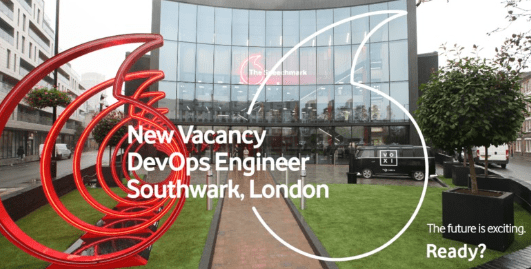
My attention was drawn to the advert above as I indulged in my early morning social media habit. What struck me was that not only did it specify the role but also the location the successful candidate should be based. The question that immediately popped into my head was – Why?
Twenty years ago, when I began my various careers, you turned up on your first day and there was a desk and phone provided for you. It’s 2020 and COVID-19 is running around the world faster than the truth can get its shoes on. Whole nations are isolating themselves and their communities in an effort to slow and stop its spread. Yet, we are still asking for the people and the skills we require at specific locations. It seems a poor approach to maintain in a global economy. Why must we determine who we are able to welcome into our organisations, based on which location our people are able to comfortably get to each day.
Our cities and our transport systems are already over-crowded to the point of being dangerous to our health and sanity. Vast amounts of investment is being poured into expanding old modes of connecting communities. There are obvious cases such as HS2 or new runways at airports. Yet the rate at which the requirement for more connectivity between communities is far outstripping the rate at which we are able to connect them.
Even today, when the Information Superhighway (remember that?) has been paved into the ubiquitous Internet, we still think of connecting our organisations in terms of bringing them physically together. This, I would propose, is a lie we tell ourselves. The lie of needing to put people in the same physical location to have them work together.
For the last decade at least I have been fortunate to work remotely whenever possible. The majority of that fortune has been self-made. Asking for forgiveness is much simpler than asking for permission. In none of my many roles during this time have I ever been ordered back to my desk. What all my leaders discovered was that my productivity was positively impacted by being predominantly remote. I have also been fortunate to lead some amazing teams. To trust them with the same freedom of responsibility to deliver without physical oversight proved a great enabler. If you are an engineer, I would much rather you were traveling the world and enriching your life while delivering for me, than sitting at a desk with your view shrinking each day to be defined by the same tired experiences. Each one of those teams took full advantage of the ability to work remotely and not one failed to increase the quality and volume of what they delivered. I am happy to report that evolving the ‘normal’ place of work to be ‘remote’ has been a positive experience for all concerned.
Removing the requirement for people to suffer the stress of a regular commute meant they had more energy and enthusiasm with which to enrich their daily activity. Trusting them with the freedom to broaden their horizons enabled them to bring that breath of vision to what they delivered for the business. Diverse modes of thinking are not only formed by the colour of skin, by what name you call God, nor the gender your identify with. I have found that they are formed by the continuous narrative your experiences build. Giving my teams the ability to define their own constraints of that narrative enabled them to go in directions I would never have thought of. It has always enriched that person, the team and the business.
It is the simple things that make the most impact. Being able to have an unhurried breakfast, take the children to school, wake up late, take a personal day, knock-off early because you need to go to a school play, be there for a friend when they need them. All these things and more build the fabric of people’s lives. When so much of our modern adult life is spent at work, allowing them to weave this fabric is an important part of modern leadership. Our job as leaders is surely to enable our people to be at their best. In a society where we see an ever increasing level of fragmentation, it is important to provide an environment that allows people to build, enjoy, repair and propagate their lives. Knowing you don’t have to start your day at 5am and dash to stand like sardines in a train carriage, changes your life in important ways. I would propose that having people ‘turn up for work’ with a smile is far more important to your business than finding them sat a desk in a building.
An agile and dexterous business is one with the ability to predict changes in their market, evolve to take full advantage of new opportunities and do so at pace.
This ability is not driven by technology. That is an easy mistake to make. Even with the advances in Artificial Intelligence and Machine Learning being employed to provide business intelligence. Executive leadership teams should remember it is still our people that matter to deliver results that count. Their behaviours, choices and mental state are what determines how they perform for us. Allowing people the space and time to live full lives while working will always deliver better results than enforced conformity. Our global economy was meant to deliver prosperity and opportunity to as many as possible. We should not demand this be at a cost to our true selves. We should not try and impose historical approaches to our people and our organisations while trying to evolve their behaviours and output.
You don’t need to see your team or colleagues in the same building to be connected to the ebb and flow of the day. You don’t need to sit in an office to belong to an organisation or a team. Humans connect at an emotional level. That rarely requires physical presence in our modernity. It requires a happy presence. Whatever we can do to enhance how happy our people feel will always deliver better for our business.
My experience has lead me to the following themes. When implemented sensitively they have rarely failed to deliver.
Do specify what you expect your people should be capable of
Don’t specify where you expect your people to be
Pay people for the skills and experience they bring, not what you think they deserve to earn in their local context
Invest in connecting your internal communities using modern collaboration technologies (my favorite stack is O365, SharePoint Online, Microsoft Teams and Azure DevOps)
Evolve your ‘day’ to be contiguous across all the time zones you operate in and allow your people to manage their availability
Diversity does not demand conformity but collaboration and happiness, enable this by finding your people where they are most comfortable
Trust your people to be adults about managing their personal and professional lives
Reduce your investment in corporate real-estate and invest those savings in global gatherings where your people can connect
Allow your people to evolve what collaboration means to them and be transparent about how you are measuring the impact on your business
How you define leadership will evolve with new modes of collaboration, beware of old empires seeking to stifle new communities
For most businesses this future is frightening, but it is happening. While there are many organisations who promise transformations, remember to begin the process; within. Seek help to clarify and guide rather than oversee or impose.
Before you pay for solutions, ask questions of your own people. You will be pleasantly surprised at how effectively people will self-organise and regulate when given the trust, capability, technology and friendship to allow that to happen.



 khushil.io
You must be logged in to post a comment.